
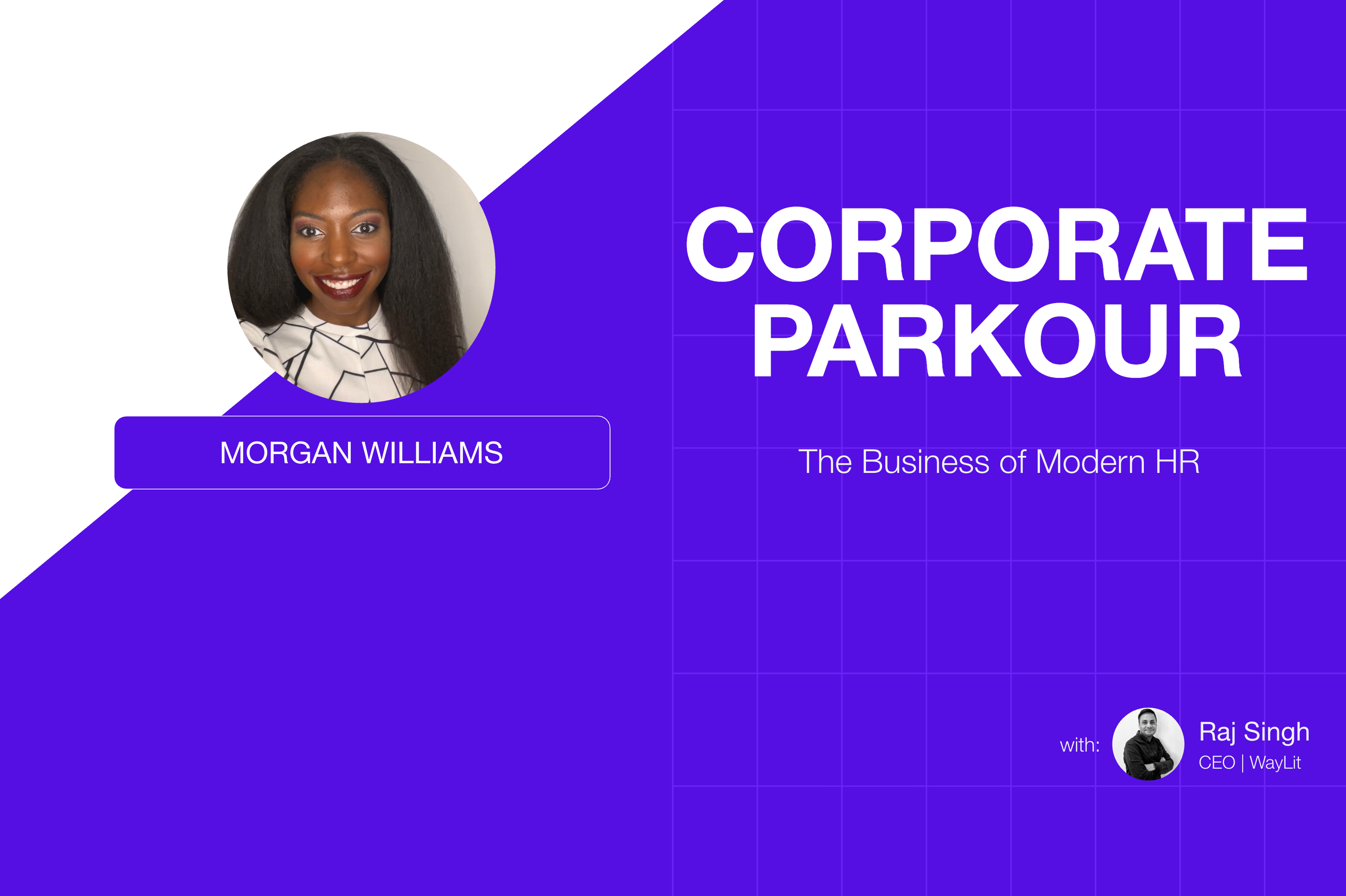
Corporate Parkour
The Business of Modern HR
In conversation with Raj Singh | CEO, WayLit
The Head of People role is often the most isolated seat in the C-Suite. You serve as the bridge between the financial goals of the business and the human realities of the workforce. You carry secrets that can move markets, and you are often the only person in the room asking how a decision will actually land.
I recently sat down with Morgan Williams (PeakHR) to deconstruct the reality of the role. Morgan is an operator's operator. She has overseen HR for organizations scaling to 300,000 employees and managed one of the largest retail workforce reductions in recent history.
We avoided abstract discussions about culture to focus on the hard stuff: the math behind benefits, the trauma of layoffs, and why "integration" is where M&A deals actually die.
Here is the unfiltered conversation.
Part 1: HR is a Revenue Function
Raj Singh: One of the biggest complaints I hear from HR leaders is that they cannot get budget approval because Finance sees them as a cost center. You have argued that we need to change the language we use.
Morgan Williams: Completely. If you walk into a CFO's office talking about fairness or morale, you have already lost. You have to speak their language, which is the P&L.
I will give you an example from a past role at a consumer goods company. We had a policy where corporate employees sitting in the HQ got a free mattress on Day 1. However, the retail employees standing in stores selling the product had to wait six months to earn one.
Raj: That sounds like a standard class divide in retail.
Morgan: It was unfair, but I avoided arguing about fairness. I looked at the data instead. I found a direct correlation. In zip codes where we had a retail store with low turnover, our e-commerce sales spiked. The retail team was not just selling in-store. They were brand evangelists driving online revenue.
So I went to the executive team and explained that while I did not need a free mattress, the sales team did. I argued that treating them like second-class citizens caused them to leave, which would ultimately kill that e-commerce spike.
Raj: You turned a perk into a revenue protection strategy.
Morgan: Exactly. The cost of the mattress was negligible compared to the cost of turnover and the lost sales velocity. We changed the policy because it made money, not just because it was nice.
Part 2: The "Survivor Effect" and The Secret Keeper
Raj: You managed a reduction in force involving 20,000 employees. We usually focus on the people leaving, but I want to ask about the people staying and the team executing it.
Morgan: The most dangerous phase of a layoff occurs the day after it happens. I call it the "Survivor Effect."
The people who stay are usually grieving rather than feeling relieved. They lost their friends and are waiting for the other shoe to drop. Without a specific plan to "re-recruit" your survivors immediately, you will see a second wave of exits within 90 days. That wave will be your top performers leaving voluntarily.
Raj: And for you personally?
Morgan: To be honest, my mental health was in shambles. As the Head of People, you know about the cuts months in advance. You sit in meetings with people you know will not be there next quarter. You are carrying secrets that qualify as insider trading if you share them. It is incredibly isolating.
Raj: How do you handle that?
Morgan: You have to humanize yourself to your team. After the notifications were done, I told my team that I cried yesterday too. You cannot be a robot. Attempting to absorb all that emotion without releasing it leads to burnout.
Part 3: The $300 Laptop
Raj: In the middle of those massive numbers, you mentioned a very small policy change that stuck with me.
Morgan: The laptops. When you are designing a severance package, everyone obsesses over the big numbers like weeks of severance or COBRA. I fought hard for a simple policy: Let the exiting employees keep their laptops.
Raj: I assume Finance hated that.
Morgan: Initially, yes. But I walked them through the "Asset Recovery" reality. These were 3-year-old machines. On the books, they were fully depreciated and worth zero. Collecting them required paying IT to wipe, ship, and recycle them. It actually costs money to take them back.
But for the employee, that laptop is a lifeline. We just cut their income, so asking them to go buy a $1,000 computer just to update their resume is a cruel burden. Sending them home with the tool they need to find their next job costs the company nothing but buys a massive amount of goodwill.
Raj: It changes the vibe from "Asset Recovery" to "Transition Support."
Morgan: Precisely.
Part 4: The M&A Trap
Raj: Shifting gears to growth. You have managed massive integrations. What is the main thing companies get wrong during an acquisition?
Morgan: They assume "Green Light" on a spreadsheet means "Ready" in real life. I have seen deals where Finance, Legal, and IT all reported green for readiness. Then Day 1 comes, and employees' badges do not work at the new office, or we have two VPs who both think they lead the same department.
Raj: "I assumed HR had that."
Morgan: That sentence kills integrations. Due diligence usually looks at the math, while integration is about the sociology. Balance sheets merge overnight, but trust does not. If HR is missing from the room during the deal modeling to ask about reporting lines and culture, you are buying chaos rather than a company.
The WayLit Takeaway
Morgan's approach highlights a shift we are seeing across the industry. The best HR leaders are no longer just Policy Enforcers. They are Business Translators.
- They translate Fairness into Revenue Protection.
- They translate Depreciated Assets into Brand Goodwill.
- They translate Immigration & Compliance into Talent Velocity.
Whether you are arguing for a budget increase or managing a complex visa process for a star engineer, the lesson remains the same. Don't just show the effort. Show the math.
For more conversations like this, subscribe to Corporate Parkour, our series on the agility of modern HR.
.svg)